What Is Hapé? A Complete Guide to Sacred Amazonian Medicine
What is Hape? A complete guide to the sacred Amazonian snuff used by Indigenous tribes - its origins, ingredients, preparation, and traditional uses.
RAPÉAMAZONIAN MEDICINESACRED PLANT MEDICINEGUIDEHAPÉ
Pillars of Light
8/17/20268 min read

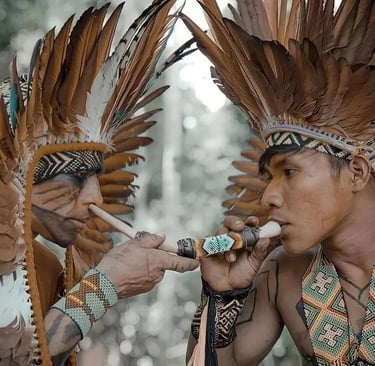
Hapé (pronounced ha-PEH), also spelled rapé, is a finely ground Amazonian snuff made from Mapacho tobacco (Nicotiana rustica) and the ash of specific trees, sometimes with other plants added. It is blown into the nostrils through a kuripe or tepi pipe and has long been used in Indigenous Amazonian prayer and ceremony.
If you have found your way to this guide, you are likely asking the first question every newcomer asks: what is hapé, really? This guide answers it honestly and respectfully. It keeps two things clearly separate: what Amazonian traditions teach about hapé, and what is actually documented about the substance itself.
Below you will learn what hapé is made of, where it comes from, how it differs from "rapé," how it is applied with the kuripe and tepi, the role it plays in Amazonian ceremony, what people mean by "hapé medicine," and how to choose and source a blend responsibly.
What is Hapé? A Clear Definition
At its simplest, hapé is a dry, powdered snuff that is taken through the nose rather than smoked or swallowed. The foundation of nearly every traditional blend is Mapacho, a strong Amazonian tobacco (Nicotiana rustica), combined with the ash of specific trees and, often, other plants, seeds, leaves, or barks. The result is a fine, earthy powder that Indigenous practitioners regard not as a recreational product but as a sacred plant with its own character and purpose. This is why people often search for it as "hapé powder" or "rapé powder": the finished blend is a fine powder, not a leaf, a liquid, or a smoking mix. You can explore our collection of authentic hapé blends, each labeled with its blend name and ingredients.
Hapé is approached with prayer, intention, and reverence, which sets it apart from casual tobacco use in the modern West. In Amazonian traditions it is used to center a person before ceremony, to mark a space as sacred, and to deepen a sense of connection to nature. When people speak of hapé as "sacred medicine," they are describing this ceremonial, prayerful relationship, built over generations between the plants, the peoples who prepare them, and the forest.
It is worth saying clearly what hapé is not. Hapé is not a psychedelic or hallucinogen, and it does not produce visions the way ayahuasca can. It does, however, contain nicotine, often a lot of it, which is why it must be treated with respect and used mindfully.
The Origins of Hapé — Amazonian Indigenous Traditions
To understand hapé, you have to understand the rainforest and the peoples who call it home. Hapé is not a modern invention. Its roots stretch back through many generations of Indigenous peoples living across the Amazon basin, primarily in what is today Brazil and Peru. In these cultures, plants are not mere resources but teachers and relatives. Hapé grew out of this worldview as a way to carry sacred tobacco and forest plants in a form that could be shared and used in daily and ceremonial life.
Several peoples are especially associated with hapé, each with their own recipes, prayers, and styles. The Yawanawá, Katukina, Nukini, Kuntanawá, Huni Kuin (Kaxinawá), and Apurinã, among others, are widely recognized as keepers of hapé traditions. A blend is often named after the people who make it or the tree ash it contains, so the name tells you something about its lineage.
Tobacco itself is one of the oldest ceremonial plants of the Americas. Long before European contact, Indigenous cultures across South America used tobacco in prayer, protection, and shamanic practice, a history documented in depth by anthropologist Johannes Wilbert in Tobacco and Shamanism in South America (Yale University Press, 1987). Hapé is one of the most refined expressions of that relationship. As interest has spread far beyond the rainforest, so has the responsibility to honor these origins.
What is Hapé Made Of?
While every people and preparer keeps their own recipes, traditional hapé is built from a few core categories of ingredients.
Mapacho — Amazonian Tobacco
The heart of hapé is Mapacho, the Amazonian name for Nicotiana rustica, a wild tobacco species that contains considerably more nicotine than the commercial Nicotiana tabacum used in cigarettes. The tobacco is dried, cured, and finely ground. It gives hapé its strength and is the source of its nicotine.
Sacred Tree Ash (Tsunu, Cumaru, Murici and others)
The second essential ingredient is ash, made by burning the bark or wood of specific trees. The ash is chosen with care and gives each blend its character. It is alkaline, which affects how the tobacco is absorbed. Well-known ashes include Tsunu (associated with the Yawanawá), Cumaru, Murici, Parika, and others. This is why two hapés made with the same tobacco can feel entirely different.
Additional Plants and Admixtures
Many blends include additional plants such as leaves, barks, seeds, flowers, and roots that shape the blend's aroma and personality. Common admixtures include cinnamon, clove, mint (such as muña), bobinsana, and a wide range of regional botanicals. You can discover more of these plants among our master plant allies. Floral blends may feature rose, grounding blends may emphasize particular tree ashes, and brighter blends may lean toward mint or citrus notes.
Rapé vs Hapé — Are They the Same Thing?
You have almost certainly seen this snuff spelled two ways, hapé and rapé. Here is the simple answer: hapé and rapé are the same thing. The difference is spelling and pronunciation, not substance.
The word comes from the Portuguese rapé, meaning snuff. In Brazilian Portuguese the initial "r" sounds close to an English "h," so rapé sounds like "ha-PEH." Many English-speaking practitioners and shops adopted the spelling hapé (sometimes hapeh or rapeh) to match that pronunciation. So whether you see rapé, hape, or hapé, you are looking at the same Amazonian snuff. Throughout this guide we use hapé.
How is Hapé Used? Kuripe and Tepi Pipes Explained
Hapé is not sniffed casually. It is blown into the nose with one of two traditional pipes. For a deeper comparison, read our Kuripe vs Tepi guide.
The Kuripe — Self-Application Pipe
A kuripe is a small, V-shaped pipe you use on yourself. One end rests at the mouth and the other at a nostril. You place a small amount of hapé in the pipe, set your intention, and blow it into one nostril, then repeat on the other side. Kuripes are traditionally made from bamboo, bone, or carved wood. Browse our handcrafted kuripes and tepis to find one for your practice.
The Tepi — Ceremonial Application Pipe
A tepi is a longer, straight pipe used when one person serves hapé to another. The server blows the snuff through the tepi into the receiver's nostrils. The tepi is central to ceremonial and group settings, where an experienced facilitator serves each participant. Explore our beaded and hand-carved tepi pipes for serving a partner or a circle.
The Ceremonial Role of Hapé
For the peoples who carry this tradition, hapé is first a spiritual and ceremonial practice. The points below describe how traditions understand it, not proven effects.
Centering. Hapé is often served at the opening of a ceremony or before prayer and meditation, as a way to bring attention into the present moment.
Clearing. In the Amazonian worldview, a person can carry heavy or stagnant energy, and hapé is traditionally understood as a way to clear it.
Prayer and connection. The moment of application is treated as an offering, a way to send intention and gratitude to the forest and to one's ancestors.
Community. Hapé is often shared in circle, where serving and being served becomes an act of reciprocity and care. If you would like to experience this in person, learn about our hapé ceremony in the Houston area or read What Is a Hapé Ceremony? A Beginner's Guide.
Hapé Medicine: Cultural Context and What Is Documented
You will often hear hapé called "hapé medicine" or "rapé medicine." It helps to understand what that phrase means, and what it does not.
What "medicine" means in Amazonian tradition
In many Indigenous Amazonian cultures, "medicine" refers to sacred plants that are used in prayer and ceremony and that carry spiritual meaning, taught and served by experienced practitioners. When practitioners call hapé medicine, they are speaking in this cultural and spiritual sense. It is not a claim that hapé treats, cures, or prevents any disease or health condition, and nothing in this guide is medical advice.
What is documented about hapé itself
Hapé is a tobacco product. Its main ingredient, Nicotiana rustica, is a tobacco species with a high nicotine content (see the USDA PLANTS Database profile). Nasal snuff is a form of smokeless tobacco. The World Health Organization's International Agency for Research on Cancer reviewed smokeless tobacco in IARC Monographs Volume 89 and classified it as carcinogenic to humans. Nicotine is also addictive.
People who take hapé commonly notice strong short-term physical reactions, such as watering eyes, a runny nose, salivation, lightheadedness, and sometimes nausea or vomiting. It is not suitable for everyone. People who are pregnant or breastfeeding, have heart conditions or high blood pressure, are sensitive to nicotine, or are under 21 should not use it. Talk with a qualified healthcare provider if you have questions about your health.
How to Choose the Right Hapé Blend
Choosing a hapé is less about finding the "best" one and more about finding the one that fits your practice.
Consider strength. Blends vary a great deal in strength depending on the tobacco and preparation. If you are new, start with a milder blend and a very small amount.
Consider aroma and character. Ash-forward blends such as Tsunu are often described as earthy and grounding, floral blends as soft, and mint or citrus blends as bright. Choose the character that suits your ceremony or practice.
Consider the lineage. Each people prepares hapé in its own style, so exploring blends by lineage and ash is a good way to learn. A reputable seller will tell you the ash and any admixtures in each blend.
Start slow. Try a small amount, notice how you respond, and let your experience guide your next choice. You can browse every blend and buy hapé online in our Hapé Apothecary or visit our shop in Old Town Spring to ask questions in person.
Responsible Sourcing — Why It Matters
Because hapé is inseparable from the Indigenous cultures that created it, where it comes from matters. Traditional preparation is slow, careful work. Responsible sourcing respects that work, the traditions behind it, and the rainforest the plants come from.
When choosing a seller, ask questions. Do they describe each blend's ingredients clearly? Can they tell you where a blend comes from and how it was made? Is it fresh, properly stored, and accurately described? Clear answers are a good sign that a seller takes both the tradition and its customers seriously.
Frequently Asked Questions About Hapé
What is hapé used for?
In Amazonian traditions, hapé is used in prayer and ceremony: to center before ceremony, to mark a space as sacred, and to share in community. It is a ceremonial tobacco snuff, not a recreational product, and it is not a treatment for any health condition.
Is hapé the same as rapé?
Yes. Hapé and rapé are two spellings of the same Amazonian snuff. "Rapé" is the Portuguese word for snuff, and because it is pronounced "ha-PEH," many English speakers adopted the spelling "hapé."
Does hapé get you high?
No. Hapé is not a psychedelic or hallucinogen and does not produce visions. It does contain nicotine, so a strong serving can cause lightheadedness and other physical reactions.
What is hapé made of?
Traditional hapé is made mainly from Mapacho (Nicotiana rustica) combined with the ash of trees such as tsunu, cumaru, or murici. Many blends also include other plants, seeds, barks, or flowers.
How is hapé applied?
Hapé is blown into the nostrils through a pipe. A kuripe is a small pipe you use on yourself, and a tepi is a longer pipe used when one person serves another. See our Kuripe vs Tepi guide for details.
Is hapé safe?
Hapé is a tobacco product that contains nicotine, and smokeless tobacco carries documented health risks. It also causes strong physical reactions and is not suitable for everyone, especially people who are pregnant, have heart conditions or high blood pressure, are sensitive to nicotine, or are under 21. This is not medical advice. Our spiritual consultation and classes cover respectful, traditional practice.
Which peoples make hapé?
Hapé is prepared by several Amazonian Indigenous peoples, each with distinct styles and recipes. Well-known lineages include the Yawanawá, Katukina, Nukini, Kuntanawá, Huni Kuin (Kaxinawá), and Apurinã.
Sources and Further Reading
Wilbert, Johannes. Tobacco and Shamanism in South America. Yale University Press, 1987.
USDA Natural Resources Conservation Service. Nicotiana rustica L., PLANTS Database.
International Agency for Research on Cancer. Smokeless Tobacco and Some Tobacco-specific N-Nitrosamines, IARC Monographs Volume 89, 2007.
Conclusion — Learning More About Hapé
Hapé is far more than a powder blown into the nose. It is a ceremonial Amazonian snuff made from Mapacho tobacco, tree ash, and forest plants, carried across generations by the Indigenous peoples who treat it as sacred. To ask "what is hapé?" is really to ask about a whole worldview built on prayer, reciprocity, and connection to nature.
If you choose to work with hapé, approach it with respect for the tradition, for the people who keep it, and for your own health. Explore our blends in the Pillars of Light Hapé Apothecary, find a pipe in our kuripes and tepis collection, or visit us at 318 Main Street, Suite D, Spring, TX 77373.
Pillars of Light, 318 Main Street, Suite D, Spring, TX 77373
Pillars of light
Orders@pillarsoflight.shop
© 2026. All rights reserved.
Part of the Pillars of Light Plant Medicine Church network.
Privacy Policy
© 2026. All rights reserved.